POST HIGHLIGHTS
- What is blood quantum? Blood quantum is the level of American Indian blood that a person possesses. Many tribes require a certain amount of blood quantum for membership.
- Is blood quantum the only requirement for tribal membership? No – some tribes ask for proof of lineal descent or a combination of characteristics, such as cultural involvement in a tribe or residency.
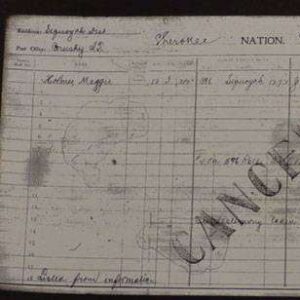
- What kind of evidence do you need to confirm your right to join a federally-recognized tribe? You need legal documents such as birth, death, and marriage certificates, deeds, and wills to demonstrate your biological connection to your Native American ancestors.
- What is a CDIB? The CDIB, or Certificate of Degree of Indian Blood, is an official U.S. document used to certify that a person does possess a percentage of Native American blood and therefore has legitimate Native ancestry. The government grants an individual a CDIB once that individual has proven their Native American genealogy.
- If you gain enrollment to a Native American tribe, do you also gain access to certain benefits? Yes – you most likely receive healthcare, educational, and housing benefits.
- Will the criteria for belonging to a Native American tribe ever change? It’s possible! The Crow Tribe of southern Montana is contemplating regarding each current tribal member as having “100% Crow blood,” regardless of blood quantum measurements.
Am I Native American?
Have you ever wondered whether you’re eligible to belong to a Native American tribe?
If so, your initial thought probably pertains to DNA: How much American Indian blood do I need to be considered a tribal member? But the truth is, multiple criteria come into play for anyone of a particular race and ethnicity who wants to uncover the details of their lineage. Culture, tradition, religion, and values, as well as legal recognition, all help to determine whether an individual “belongs” to a certain group.
So first, let’s confirm who the Native American people truly are. Native Americans are the individuals who contain the blood of one of the more than 500 distinguished tribes that still endure as sovereign states within the United States’ present geographical boundaries. These are the Native American tribes that descended from the pre-Colombian indigenous peoples of North America.
Blood quantum, or the level of American Indian blood that a person possesses, does factor into eligibility when a Native American tribe is considering granting someone membership. However, any tribe can decide on its own guidelines for tribal citizenship, as long as those guidelines follow rules set by the United States government. According to Legal Clarity, some tribes ask for a specific blood quantum, while others prioritize direct descendence from an original member on a tribal roll. In any case, the U.S. government would need proof of genealogy before bestowing official tribal rights on you, which means that you would need to establish your line of descent from an ancestor who was an enrolled member of a now federally-recognized tribe. How should you begin the process of gathering your evidence?
Related Info – Native American Ancestry — What % of Native American am I?
Find Your Family History
The United States Department of the Interior encourages you to interview any family member you can about your grandparents, great grandparents, and even more distant relatives. What were their birth and death dates? Whom did they marry and when? Where did they live? Go searching in photo albums, scrapbooks, memento boxes, and drawers for any kind of physical document that might give you a clue of your ancestry, such as birth and marriage certificates. You can also visit county courthouses or reach out to vital statistics offices for these papers, as well as for deeds and wills. In addition, genealogy services can help. For example, Genealogy Bank’s archives contain thousands of resources on Native American history, including newspaper articles on the American Indian Wars, the Trail of Tears, and the origin of reservations. This online genealogy subscription service also provides monographs – detailed written studies – on North American Indians through their Bureau of American Ethnology publications. Another source is The National Archives, as they carry documents dating back to 1774, where you can find Bureau of Indian Affairs (BIA) information, tribal census rolls, historical treaties, and allotment records.

PowWows.com earns commission from Ancestry.com
Related Info – What Native American tribe am I from?
The Certificate of Degree of Indian Blood (CDIB)
The strongest piece of evidence for your Native American heritage would be a Certificate of Degree of Indian Blood, or a CDIB. The CDIB is an official U.S. document used to certify that a person does possess a percentage of Native American blood and therefore has legitimate Native ancestry. Don’t forget, though, that the blood must be identified with a federally-recognized Native American tribe. For a person to be considered Native American by the United States government, they must either have one of these cards or be enrolled in a tribe. The CDIB shows the constituent blood degree of a particular tribe or that of all tribes in an applicant’s ancestry. Of course, the percentage required by each tribe to enroll varies. For instance, the Eastern Band of Cherokee Indians requires a minimum of 1/16 degree of Cherokee Indian blood for tribal enrollment, while the Bureau of Indian Affairs’ Higher Education Grant seeks a minimum of 1/4 Native American blood percentage. The Bureau of Indian Affairs issues the certificate after the individual has forwarded a finalized genealogy.
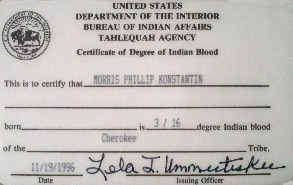
Once you have family records that testify to your Native American lineage, you must contact the tribe you believe you belong to and submit an application for enrollment. And then…you wait for news! If you discover that you are eligible to join a Native American tribe, you will gain access to benefits such as healthcare services through the Indian Health Service, educational programs through the Bureau of Indian Education, and housing through The Department of Housing and Urban Development.
Related Info – DNA Results vs. Tribal Enrollment vs. Certificate of Degree of Indian Blood — What Do They All Mean?
Tribal Belonging: It’s Complicated!
We do need to remember that in today’s world, the issue of tribal belonging raises a lot of complications. While some tribes depend on blood quantum or tribal descent, others evaluate a combination of blood quantum, lineal descent, and other criteria in order to grant or deny membership. The Navajo Nation requires proof of 1/4 Cherokee ancestry through blood quantum; the Choctaw Nation wants to see direct descent from a documented tribal member or ancestor; and the Osage Nation considers factors such as cultural involvement and residency (Native Americans Today). The quest to define who can and cannot belong to a tribe continues on, as any decision that a tribe makes about requirements calls into question the very definition of Indigenous identity.
Recently, the Crow Tribe of southern Montana decided to analyze the ethical implications of blood quantum requirements, which have always maintained that an individual must have 1/4 Crow Indian blood to enroll. The concept of blood quantum first appeared as the Indian Blood Law in 1705, when white settlers in Virginia invented this method for judging how “Indian” a Native American person seemed based on qualities such as skin color. Frank Whiteclay, chairman of the Crow Tribe, has proposed that all existing members of the tribe be regarded as having 100% Crow “blood.” This change in policy would embrace the current 14,000+ tribe members as pure Crow citizens, as well as these members’ descendants for decades to come.
Blood Quantum Calculator
Tribal Blood Quantum Calculator and Requirements
A Blood Quantum Calculator can help you zero in on the origin of your American Indian heritage.
For instance, if you are 50% Native American or half blood quantum, that means you have one parent who’s of direct Native American lineage/half-blooded quantum.
If you are 25% American Indian or one-quarter blood quantum, that means you have one grandparent who’s of direct Native American lineage.
The same conversion rate applies as you reach further down the line. If you are 12.5% American Indian or one-eighth blood quantum, you have one great-grandparent of Native American lineage.
If you are 6.25% or one-sixteenth blood quantum, you have one great-great-grandparent, and so on.
Read more about Blood Quantum laws here.
Below is a list of some tribal requirements. This is not a comprehensive list, but rather a sampling of the more than 500 federally recognized tribes.
Native American Tribal Enrollment Requirement
50 Percent/One-Half Blood Quantum (One Parent)
Kialegee Tribal Town
Miccosukee Tribe of Indians of Florida
Mississippi Band of Choctaw Indians, Mississippi
St. Croix Chippewa Indians of Wisconsin
White Mountain Apache Tribe, Arizona
Yomba Shoshone Tribe, Utah
25 Percent/One-Fourth Blood Quantum (One Grandparent)
Absentee-Shawnee Tribe of Native American Indians
Cheyenne and Arapaho Tribes
Confederated Tribes and Bands of the Yakama Nation, Washington
Oneida Tribe of Indians, Wisconsin
Kickapoo Tribe of Oklahoma
Pascua Yaqui Tribe, Arizona
Kiowa Tribe of Oklahoma
Prairie Band Potawatomi Nation, Kansas
Navajo Nation, Arizona, Utah and New Mexico
Shoshone Tribe of the Wind River Reservation, Wyoming
Fort McDowell Yavapai Nation, Arizona
Standing Rock Sioux Tribe, North and South Dakota
Utu Utu Gwaitu Paiute Tribe, California
Havasupai-Prescott Tribe, Arizona
United Keetoowah Band of Cherokee Indians, Oklahoma
Fort Peck Assiniboine and Sioux Tribes, Montana
St. Regis Mohawk Tribe, New York, Canada
12.5 Percent/One-Eighth Blood Quantum (One Great-Grandparent)
Apache Tribe, Oklahoma
Comanche Nation, Oklahoma
Delaware Nation, Oklahoma
Confederated Tribes of the Siletz Reservation, Oregon
Fort Sill Apache Tribe, Oklahoma
Karuk Tribe, California
Muckleshoot Indian Tribe of the Muckleshoot Reservation, Washington
Northwestern Band of Shoshoni Nation of Utah (Washakie)
Otoe-Missouria Tribe of Native American Indians, Oklahoma
Pawnee Nation, Oklahoma
Ponca Nation, Oklahoma
Sac and Fox Nation, Oklahoma
Sac & Fox Nation of Missouri, Kansas and Nebraska
Squaxin Island Tribe of the Squaxin Island Reservation, Washington
Suquamish Indian Tribe of the Port Madison Reservation, Washington
Three Affiliated Native American Tribes of the Fort Berthold Reservation
Upper Skagit Indian Tribe of Washington
Wichita and Affiliated Tribes (Wichita, Keechi, Waco and Tawakonie)
6.25 Percent/One-Sixteenth Blood Quantum (One Great-Great-Grandparent)
Caddo Nation
Confederated Tribes of Siletz Indians
Confederated Tribes of the Grand Ronde Community of Oregon
Fort Sill Apache Tribe
Iowa Tribe of Oklahoma
Sac and Fox Nation, Oklahoma
Eastern Band of Cherokee Indians, North Carolina
Lineal Native American Descent
Alabama-Quassarte Tribal Town
Cherokee Nation
Chickasaw Nation
Choctaw Nation
Citizen Potawatomi Nation
Delaware Tribe of Indians
Eastern Shawnee Tribe
Kaw Nation
Mashantucket Pequot Tribe of Connecticut
Miami Tribe of Oklahoma
Modoc Tribe
Muscogee Creek Nation
Osage Nation
Ottawa Tribe of Oklahoma
Peoria Tribe of Indians
Quapaw Tribe of Oklahoma
Sault Ste. Marie Tribe of Chippewa Indians of Michigan
Seminole Nation
Seneca-Cayuga Tribe of Oklahoma
Shawnee Tribe
Thlopthlocco Tribal Town
Tonkawa Tribe
Wyandotte Nation
No products found.
PowWows.com earns commissions from Amazon.com
Last Updated on March 9, 2026 by lizmastrangelowritingcoach