Previous articles gave overviews and some tips on navigating through the Dawes Rolls. This article follows up on some information on those common arguments on who is and who is not Cherokee because of three classifications: Holdout, Doubtful and Reject.
Holdout
Holdouts were a group of Cherokees that belonged to several societies in the Cherokee Nation mostly made of Full-Bloods. The Nighthawks was one such society that was very vocal in the refusal to enroll and accept the Allotment from the Dawes Commission. The leader was a Cherokee named Redbird Smith who throughout his life worked to return to a more traditional society. He was a National Councilman and very vocal in his outspoken views regarding Allotment. But the Dawes Commission was relentless and he was arrested in 1902 and forced to enroll. His followers, some 5000 or so, continued for another year or so to reject enrollment, but they were enrolled without consent and finally allotted land and money.
Recount of Author on a Holdout Example
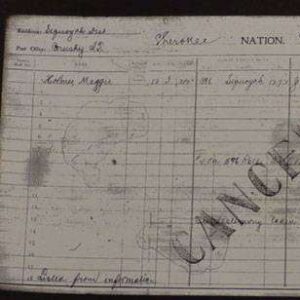
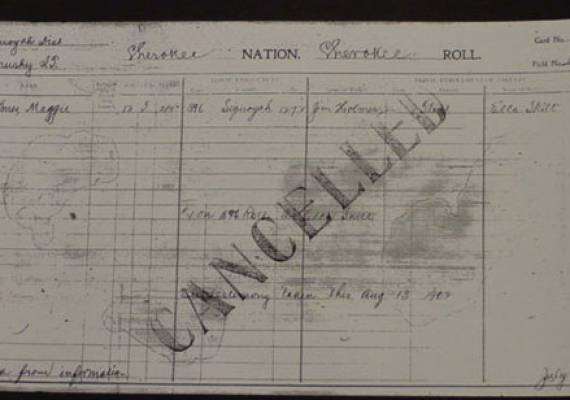
While I was researching my own ancestry I came upon the application of my Great Grandfather dated April 23, 1902. The testimony is given by Sarah Swimmer his Mother-in-Law. She gave testimony for her daughter Evabelle Hawkins who was “sick and feeble” and could not come in to apply. Swimmer testified that Evabelle was married to Josiah Hawkins and they had two children at the time. The commission then asked if Josiah would come in and it was mentioned that he refused to come in and testify. The Commission asked about any possible relation to the Nighthawks Society and Swimmer testified “yes.” They continued the interview and then enrolled Evabelle, Josiah and the children with no need for any of them to appear in person.
Doubtful
Doubtful was a category the Commission used to define an applicant that they found doubtful at the time of enrollment and later they would do a deeper investigation to either approve or reject the application. The category Doubtful would have a roll number but it would start with the letter “D” found in the index. There were some 3700 or so of these marked as Doubtful. Overtime the Dawes Commission would weed through the applications and would enroll them and issue a Straight Roll number or they would reject them altogether.
Another type of “doubtful” was the same “red flag” that comes up today: the claiming of multiple Tribes. The Cherokee Nation and The Commission had issues with applications in which one claimed many Tribes. A review of census cards showed some applicants were marked “Doubtful” because they claimed they were several tribes and lived with these other Tribes as such. Census records from The Cherokee Nation and other investigations helped The Commission to make a status judgment on these applications.
Reject
Rejects were the last category and in most cases it was applications that the Cherokee Nation advised against enrolling for various reasons.
Some rejection cases were regarding intermarried whites with a Cherokee by blood. At that time a Cherokee could marry a Non-Cherokee and they could live within the Cherokee Nation as a citizen. The children of this type of marriage would be enrolled as Cherokee by blood. That seems simple enough but it was found that many cases involved “bigamy” in which the Cherokee Man had stopped living with his first wife and had taken a second wife without divorcing the first. Bigamy was a “red flag” for both the Cherokee Nation and The Dawes Commission.
Marriage and Divorce was very simple among the Cherokee but could cause some issues for enrollment. Cherokee Law 1885 Section 96 Page 230 reads: “No particular form of marriage shall be required in the solemnization of marriages, except that the parties shall solemnly declare in the presence of a Judge, a Clerk or Minister officiating or the attending witness that they take each other as Husband and wife.”
Divorce was just as simple as one just had to register the fact of divorce with their courthouse. The children would always have rights to citizenship as Cherokees by Blood but there may be questions on citizenship for the divorcee.
Still other cases for rejection involved inconsistency with when one moved to Indian Territory but failed to request admittance by The Cherokee Nation Council or cases were applicants declared living within the boundaries but were rejected fairly quickly due to the fact that they were not enrolled by the Cherokee Nation in 1880 or 1896.
For the most part, rejection cases involved just plain fraud from people that had no connection of any kind whatsoever to the Cherokee or any Native American Tribe. This was very common as money and land allotments cause people to lie about anything including heritage.
Conclusion
The Dawes Commission, for the most part, used the official Documents that had been done and approved by the Cherokee Nation Council including the 1880 Census and the 1896 Census. So when the Dawes Commission set up in Indian Territory they already knew who was considered Cherokee by The Cherokee Nation itself. This is perhaps the most misunderstood part to the Dawes Rolls and why many argue what the Dawes Commission was doing. In reality, The Dawes Commission was merely double checking the following information from The Cherokee Nation: 1) who made applications and 2) who was still living at the time of the Commission.
Finally and most important was the fact that one need not be present for enrollment as The Dawes Commission already had the name from The Cherokee Nation and they were just checking to see if one was still breathing. Anyone that had a hard time “proving” Cherokee Citizenship was usually found to have no connection with the Cherokee Nation in the past and they also hah no relations that were connected to the Cherokee Nation in the past.
References:
Garrick Bailey and Roberta Glenn Bailey, “Redbird Smith,” in Encyclopedia of North American Indians, ed. Frederick E. Hoxie (Boston: Houghton Mifflin, 1996).
Personal research of the Author on his own Genealogy.
Last Updated on July 29, 2024 by Paul G