The languages among the Native American tribes are many. Some are very similar to each other and some are very different. Together, the native languages of the Americas are among the most numerous and varied in the world, which provides scholars with rich sources of information on the many ways people make speech and language.
The number of distinct languages in North America figures in the hundreds, however, by studying similarities and differences, scientists have placed most tribes into one of about 12 groups. Their theory is that all tribes assigned to one group were once one tribe living in the same area. Listed below are some of the groups and some of their modern day tribes:
Algonkian:
Chickasaw, Choctaw, Cree, Creek,
Lumbee, Micmac, Ojibwa
(Chippewa), Ottawa, Potawatomi,
Seminole and Blackfeet (Siksika)
Athapaskan:
Apache, Navajo, and Tlingit
Aztecan-Tanoan:
Aztec, Comanche, Hopi, Kiowa,
Paiute, Pima, Shoshoni,
Tarahumara, Tohono O’odham
(Papago), Ute, and Yaqui
Caddoan:
Pawnee and Wichita
Eskimoan:
Aleut and Eskimo
Hokan:
Yuman (Cocopah and Mohave)
Keres:
Keres (Cochiti and some other
tribes of the upper Rio Grande
area in the southwest)
Mayan:
Quiche, Tzotzil, and 29 others
Siouan:
Cherokee, Crow, Dakota and
Lakota (Sioux), Ho-Chunk
(Winnebago), Huron or Wyandot,
Iroquois (Cayuga, Mohawk,
Oneida, Onondaga, and Seneca)
Penutian:
Yakima and Zuni
Salish:
Salish
The above list is just a small sampling of the different languages found across North America. According to Wikipedia, there are over 296 separate spoken languages. The full classification of the North American languages can be seen in the map below.
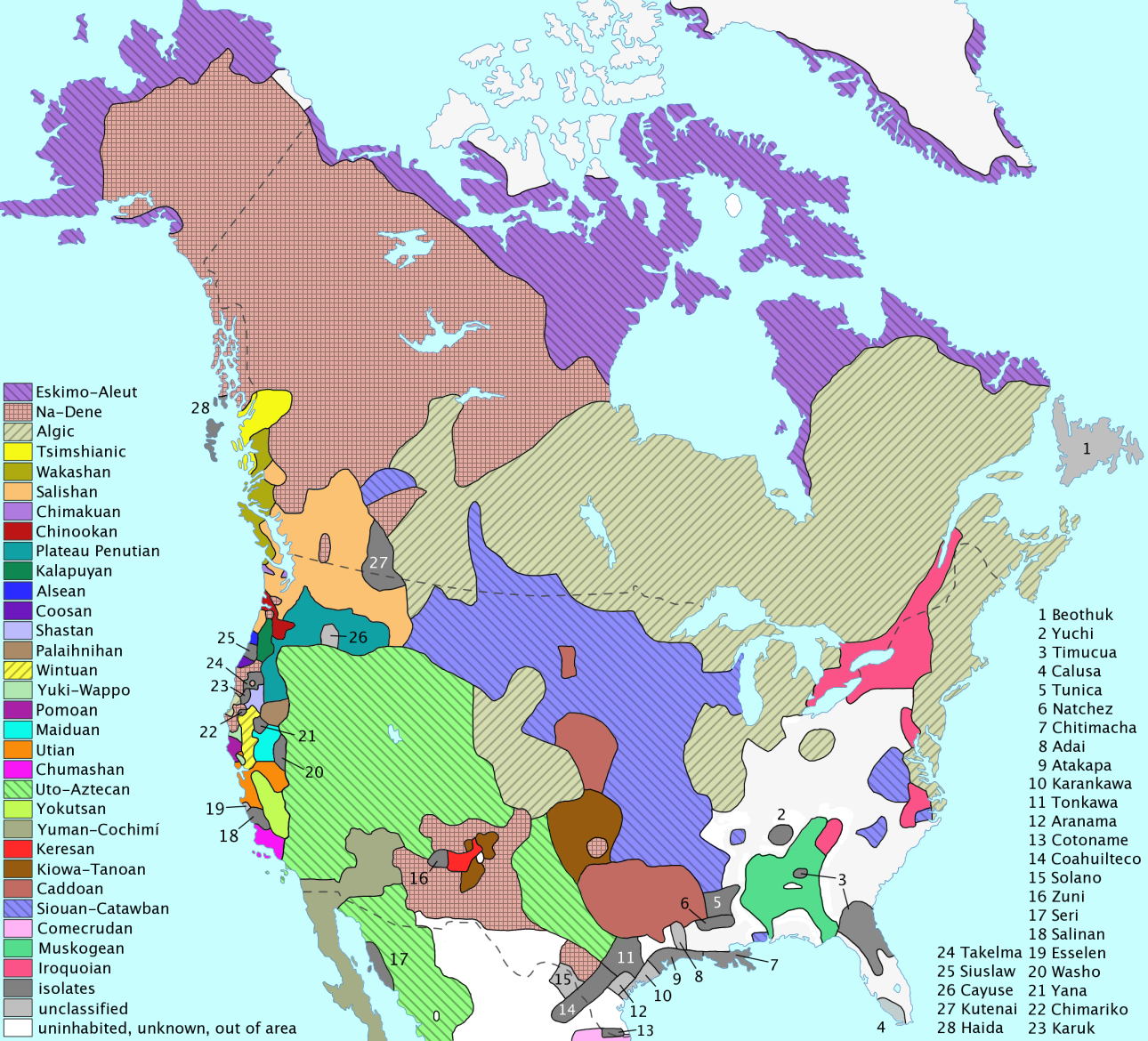
North American Indegenious Languages
- Adai
- Algic
- Alsean
- Atakapa
- Beothuk
- Caddoan
- Cayuse
- Chimakuan
- Chimariko
- Chinookan
- Chitimacha
- Chumashan
- Coahuilteco
- Comecrudan (United States & Mexico)
- Coosan
- Cotoname
- Eskimo–Aleut
- Esselen
- Haida
- Iroquoian
- Kalapuyan
- Karankawa
- Karuk
- Keresan
- Kutenai
- Maiduan
- Muskogean
- Na–Dené (United States, Canada & Mexico)
- Natchez
- Palaihnihan
- Plateau Penutian
- Pomoan
- Salinan
- Salishan
- Shastan
- Siouan–Catawban
- Siuslaw
- Solano
- Takelma
- Tanoan
- Timucua
- Tonkawa
- Tsimshianic
- Tunica
- Utian
- Uto-Aztecan
- Wakashan
- Wappo
- Washo
- Wintuan
- Yana
- Yokutsan
- Yuchi
- Yuki
- Yuman
- Zuni
For more information on languages of the First Nations in Canada please visit FirstVoices.com.
Source: The Indian Way CD by Mark Thiel and Wikipedia
Purchase the Indian Way CD from Noc Bay
Last Updated on December 27, 2016 by Paul G