Most people went through 12 years of school and learned almost nothing about Native history. That’s not an accident. Here are five things that should have been in your textbook.
There’s a version of American history most of us were taught. Pilgrims, Columbus, Lewis and Clark, the Wild West. Somewhere in the margins, Native Americans appear, mostly as backdrop.
That version leaves out a lot.
It leaves out a civilization that was, at its peak, larger than London. It leaves out one of the most important legal minds in 19th-century America — a man who invented something no single person had ever done alone before him. It leaves out a military force so dominant it stopped the Spanish Empire cold for 150 years. It leaves out a network of nations whose system of government helped inspire the one that now governs 330 million people.
These are not footnotes. These are the stories that explain how this continent actually works.
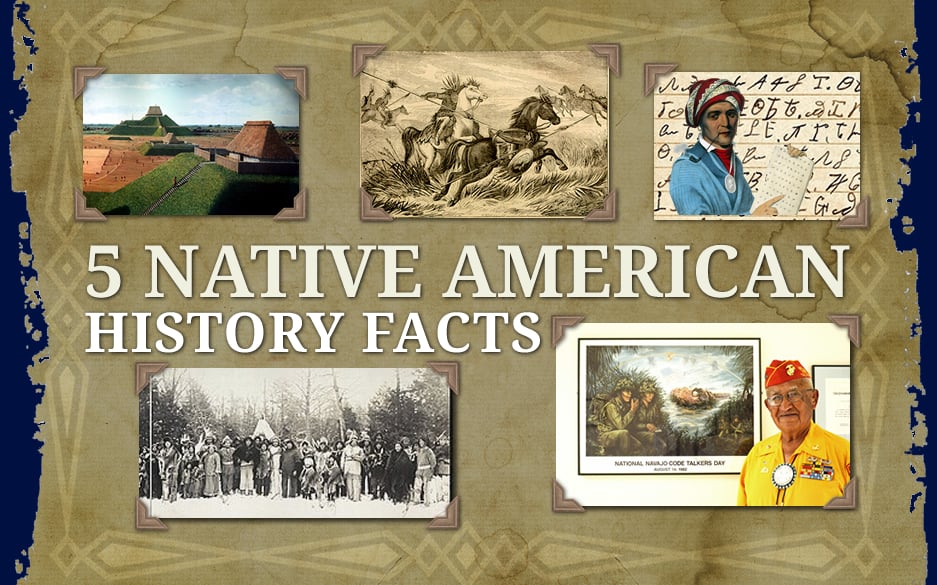
1. There Was a City in Illinois Larger Than London — and Almost Nobody Knows Its Name
Around 1100 AD, on the floodplain just east of where St. Louis now stands, there was a city.
It wasn’t a village. It wasn’t a settlement. It was a city, with a population estimated between 10,000 and 20,000 people at its height — which made it larger than London at the same point in time, and larger than any city in North America until Philadelphia surpassed it in the 18th century.
It was called Cahokia, built by the people archaeologists now call the Mississippians. At its center stood a massive earthen mound — Monks Mound — that covers more ground at its base than the Great Pyramid of Giza. Around it, more than 120 smaller mounds spread across six square miles, organized around open plazas in a layout that required serious engineering and city planning.
Cahokia had neighborhoods. Woodhenge — a series of large timber circles used to track the solstices and equinoxes. Evidence of a sophisticated trade network stretching from the Gulf of Mexico to the Great Lakes. Copper, shells, and carved stone from hundreds of miles away.
It was abandoned by around 1350, likely due to a combination of flooding, deforestation, and political collapse. Nobody knows exactly why. The people who built it left no written record we have decoded.
The site sits just outside St. Louis. It is a UNESCO World Heritage Site. It is visited by far fewer Americans every year than Mount Rushmore, which was carved into a sacred Lakota mountain 600 years after Cahokia was already gone.
Most Americans have never heard of it.
2. One Man Invented an Entire Writing System in About 12 Years
In the entire recorded history of the world, only a handful of people have created a complete writing system by themselves, from scratch, in their own lifetime. Sequoyah is one of them.
Sequoyah was born around 1770, the son of a Cherokee mother and likely a European-American father he never knew. He was a silversmith, a fur trader, and, by most accounts, illiterate in any language for most of his early life.
Sometime around 1809, he became fascinated by what he called “talking leaves” — the written pages he saw English speakers using. He didn’t know what the letters meant, but he understood that marks on a surface could carry language across distance and time. His people didn’t have that. He decided to give it to them.
For over a decade, while people in his community thought he had lost his mind, he worked on a system of symbols representing the sounds of the Cherokee language. He tried and discarded an alphabet approach. He eventually settled on a syllabary — 86 symbols, each representing a syllable rather than a single sound — that matched perfectly with the natural phonetics of Cherokee.
He finished around 1821. Within months, thousands of Cherokees had learned to read and write. Within a few years, the literacy rate among Cherokee people surpassed that of many white American communities. By 1828, the Cherokee Nation had its own newspaper, the Cherokee Phoenix, printed in both English and Cherokee — becoming one of the first Native American newspapers in history.
Sequoyah never learned to read or write English. He did the whole thing in Cherokee, for Cherokee people, because he believed they deserved to tell their own story in their own words.
The giant sequoia trees of California are named after him.
3. The Comanche Stopped the Spanish Empire Cold for 150 Years
When most people picture the Great Plains tribes on horseback, they assume that’s just how it always was. It wasn’t.
Horses had gone extinct in North America roughly 10,000 years before Spanish explorers reintroduced them in the 1500s. The Comanche were among the first tribes to acquire them, in the early 1700s, and what happened next was one of the most dramatic military transformations in history.
Within a generation, the Comanche had become arguably the most skilled light cavalry force in the world. They mastered riding at a level that genuinely shocked European military observers. Comanche warriors trained from childhood to hang off the side of a moving horse while firing arrows from underneath its neck — an essentially impossible target to hit while presenting almost no target themselves. They could fire up to 20 arrows per minute at a full gallop. The rifles of the era could barely manage one shot per minute.
The Spanish Empire, at its peak one of the most powerful military forces on Earth, could not subdue them.
For over 150 years, the Comanche — who called their territory Comancheria — effectively controlled the southern Great Plains, stretching from Kansas to northern Mexico. They raided Spanish settlements for horses and goods, took captives, and operated a sophisticated trade and ranching economy. They didn’t just resist Spanish expansion. They pushed it back. The Spanish frontier in Texas moved south during the height of Comanche power, not north.
When the Americans arrived, it took the U.S. Army decades of brutal, sustained military campaigning to end Comanche dominance — and they only succeeded by targeting the horse herds directly, killing thousands of animals in winter to take away the foundation of Comanche power.
The Comanche Empire is one of the most extraordinary political and military stories in North American history. It is almost entirely absent from standard American curricula.
4. The Code Talkers Weren’t Just Navajo — and the Story Goes Back to World War I
Most people who know anything about Native American code talkers know about the Navajo Code Talkers of World War II — the 400-plus Navajo Marines whose unbreakable code helped win the war in the Pacific. That story is remarkable and true.
What most people don’t know is that it wasn’t new. And it wasn’t only the Navajo.
In World War I, the Choctaw Nation of Oklahoma provided the U.S. Army with its first Native code talkers. In October 1918, during the Meuse-Argonne Offensive — one of the bloodiest campaigns of the war — German forces had been intercepting and decoding American communications. A U.S. Army captain, overhearing two Choctaw soldiers speaking their language, had an idea. He organized a network of Choctaw speakers across his battalion and had them transmit orders in their language. Within 24 hours, the tide of that engagement shifted. The Germans never cracked it.
The Choctaw Code Talkers were never formally recognized by the U.S. government during their lifetimes. Most died without acknowledgment. Congress awarded them the Congressional Gold Medal in 2008 — 90 years after they helped win the war.
In World War II, it wasn’t just the Navajo. Cherokee, Lakota, Meskwaki, Chippewa, Oneida, and other nations all contributed code talkers. Over 400 Native Americans served in communication roles where their languages were used as operational codes. Many of these men came from nations where speaking their language in school had been illegal within living memory — where children had been beaten for using the words they were now being asked to speak for their country.
They served anyway. And the United States classified their contributions for decades after the war ended, in part to preserve the codes for future use.
5. The Iroquois Confederacy Was Functioning Democracy Centuries Before America Was
In 1987, the United States Senate passed a resolution acknowledging that “the confederation of the original 13 colonies into one republic was influenced by the political system developed by the Iroquois Confederacy.”
That resolution existed because historians and Indigenous scholars had spent years documenting what many people still don’t know: the Haudenosaunee — the Six Nations of the Iroquois Confederacy — had been operating one of the most sophisticated systems of representative democracy anywhere in the world since approximately 1450, and possibly much earlier.
The Great Law of Peace, which governs the Haudenosaunee Confederacy, established a bicameral legislature, required consensus-based decision making, protected freedom of speech in deliberation, and included a mechanism for removing leaders who abused their power. Women held the power to nominate and remove chiefs. No decision affecting all six nations could be made without the agreement of representatives from each.
Benjamin Franklin studied it. He attended multiple treaty councils with Haudenosaunee leaders and wrote admiringly about their political structure, noting that a confederacy of Native nations had managed to maintain unity and peace far more successfully than the European colonies had. “It would be a strange thing,” he wrote in 1751, “if Six Nations of ignorant savages should be capable of forming a scheme for such a union… and yet that a like union should be impracticable for ten or a dozen English colonies.”
He didn’t mean it as a compliment to the Haudenosaunee exactly. But the comparison was there. And he kept thinking about it.
The constitution the founders eventually wrote did not copy the Great Law of Peace directly. But the structural similarities — separate deliberative bodies, enumerated rights, mechanisms for removing leaders — are not coincidence. The model existed. The founders knew about it. And the people who built it had been practicing it for centuries.
There’s So Much More
These five stories are not outliers. They are not rare exceptions that survived when most of the record was lost. They are representative of a history that is vast, complex, sophisticated, and almost entirely untaught.
The agricultural revolution that feeds the world today started here. The words in your mouth have Native roots you’ve never been told about. A single land rights case from 1999 redrawn the legal map of an entire state. A family from the Canadian plains performed at the Grammy Awards.
All of it real. Almost none of it in the textbook.
That is exactly why we built This Week in Native History.
Every week, one story like the ones above lands in your inbox. A person history walked past. A decision that changed everything. A moment that deserved to be told a long time ago.
It’s a newsletter for people who are done with the version of history that left this much out.
Subscribe to This Week in Native History →