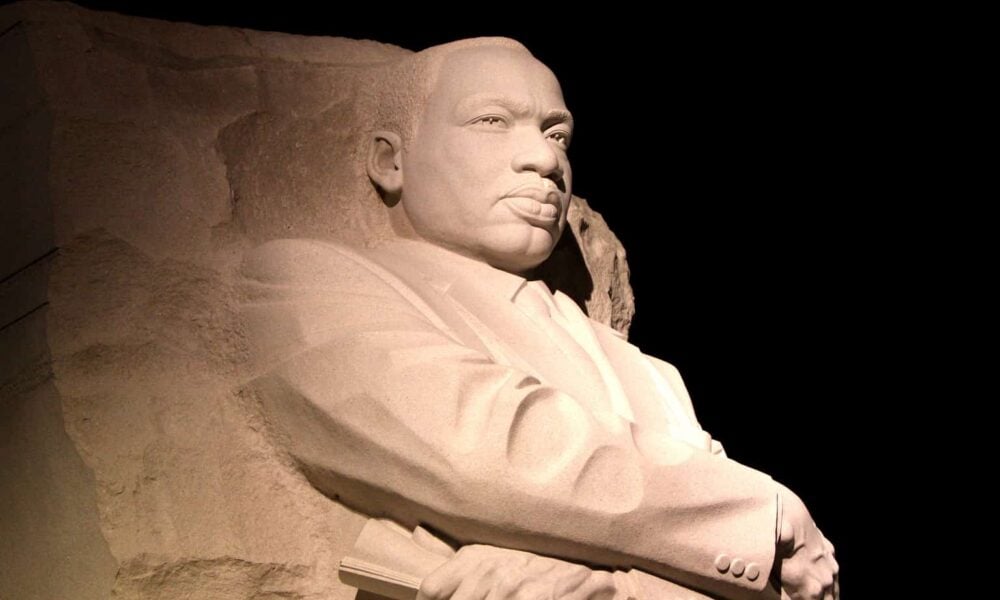
As we celebrate Martin Luther King Jr. Day, we look back people on the indelible mark left behind by the famed civil rights hero best known for his work on racial equality and ending racial segregation in the United States.
But lesser known is King’s work as a freedom fighter for Native Americans and against the U.S. government’s atrocious mistreatment of them. In his 1963 book, “Why We Can’t Wait,” which examines the historic injustices toward Native people, King wrote:
“Our nation was born in genocide when it embraced the doctrine that the original American, the Indian, was an inferior race. Even before there were large numbers of Negroes on our shores, the scar of racial hatred had already disfigured colonial society. From the sixteenth century forward, blood flowed in battles of racial supremacy. We are perhaps the only nation which tried as a matter of national policy to wipe out its Indigenous population. Moreover, we elevated that tragic experience into a noble crusade. Indeed, even today we have not permitted ourselves to reject or feel remorse for this shameful episode. Our literature, our films, our drama, our folklore all exalt it.”
Unfortunately, many of King’s words resonate as much today as ever before. King was, first and foremost, a champion for all of the oppressed. He understood that until there was equality for all, there was equality for nobody.
How Martin Luther King Jr. Helped Native Americans
In the late 1950s, King worked with tribal leaders of the Poarch Band of Creek Indians working to desegregate their schools in South Alabama. The tribe had reached out to King after learning of King’s desegregation campaign in Birmingham, so he willingly helped.
At the time, Native children were allowed to ride school buses to previously all-white schools, but dark-skinned Native kids from the same band were not allowed to ride the same buses. With King’s assistance, the problem was resolved and Native kids from the same band were allowed to ride on the same buses, marking a major step toward desegregation.
At the 1964 March on Washington, Native Americans showed up in full force. King’s civil rights movement had, in part, motivated the Native American rights movement of the 1960s. In fact, the Native American Rights Fund was modeled after the NAACP’s Legal Defense and Education Fund.
By 1900, the Native American population in the U.S. had dwindled from tens of millions down to just 237,196, per census bureau numbers. According to King, the genocide of American Indians was “national policy.”
Today, however, the Native American population has grown to 6.9 million people (alone or in combination with another race), representing nearly 2 percent of the national population. By 2060, the U.S. American Indian and Alaska Native population is estimated to reach 10 million people, or approximately 2.4 percent of the U.S. population.
And while there’s still immeasurable work to be done, King’s influence on the Native American rights movement, and, of course, on the U.S. and the world at large, can’t be overstated.
Last Updated on January 27, 2021 by Jared McKiernan