One may argue that the Guion Miller Roll is perhaps one of the most important Rolls ever done of the Cherokee Nation in a Genealogical sense. This roll is more formally referred to as the Eastern Cherokee Emigrant Payroll. The roll was taken roughly the same time as the famous Dawes Roll, but the similarity’s end there. The Roll is a list of Cherokees that applied for compensation arising from the judgment of the United States Court of Claims on May 28, 1906, for the Eastern Cherokee Tribe. Approximately 46,000 people applied for compensation but not all were admitted.
Basically, this was a payment roll ($133.33 per person) for the Eastern Cherokee and their descendants that had been removed from the Southeast. It was not a citizenship roll as the Dawes Roll was. The Guion Miller Roll lists Cherokees in two broad categories: Cherokees residing East of the Mississippi and Cherokees residing West of the Mississippi. This compensation did not apply to those Cherokees that had left the East prior to 1835 and were covered by the Treaty of 1828 what we today call the Old Settlers. The Old Settlers received compensation in 1896 for loss of lands and other goods promised them by treaties of 1828 and 1832.
Criteria
The Guion Miller Roll has several criteria that had to be met in order to be accepted as Cherokee. 1) The applicant could not be an Old Settler or Descendants of one and 2) the applicant or an ancestor had to be listed on one of three other rolls. These three other rolls were the 1851 Chapman Roll listing those Cherokees that remained in the East; the 1851 Drennen Roll which listed those that had been moved to the West; and the 1835 Henderson Roll which immediately preceded forced removal.
Another important point was that one did not have to reside within the Cherokee Nation in Indian Territory or the Qualla Boundary in North Carolina. Adults and minor children were included in this roll just as in the Dawes Roll.
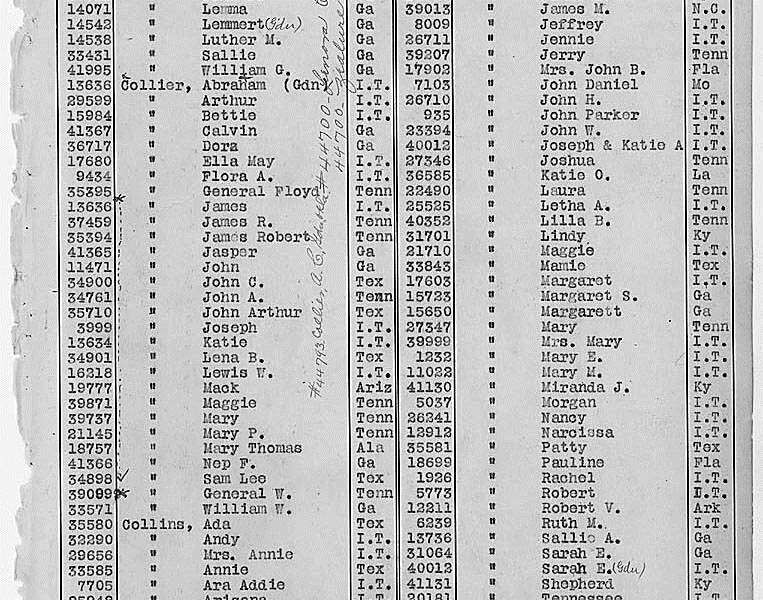
The importance of the Guion Miller Rolls is the fact that an applicant listed parents’ names in both English and Cherokee as well as listing Grandparents and siblings. The key was to list as much as the applicant could remember. Of course, memory is an elusive thing; one sibling has a better memory than another but on this roll one can compare both. To begin one must have the complete names of ancestors that they believe may have been listed in the index. Another useful fact is the Guion Miller Roll also listed the Dawes Roll number (that is if an ancestor was on the Dawes Roll). This, of course, becomes very helpful in finding an ancestor.
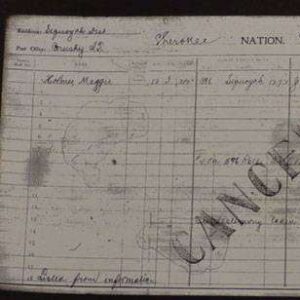
After one finds the ancestor in the index they may have their application number assigned to them (this will not be the same as the Dawes Roll number as this roll pertained to all Cherokees East and West). Then one looks in the application section of the Roll using the number that was found in the index. This will bring up the pages of the application. Usually, the original document was made up of three pages along with the addition of supporting documents and a cover page. On the Cover page, one will find in the upper right-hand corner either the terms “Accepted” or “Rejected” and information on why. If “Rejected,” the document will describe that the person has no prior connection to the Cherokees in the West or East. If “Accepted,” the document will list who the ancestor was and in some cases, the applicant will be named as such and where one can find them on either the Chapman or Drennen or Henderson Rolls.
Names
The Cherokees used several names throughout their lives most especially those that were born before 1900 and earlier. This was a cultural thing and an English thing in some cases. Before 1900 most full blood Cherokees did not speak much English and hardly wrote English at all, and thus most applications used a mark (x) as a signature. So through an interpreter, the applicant would attempt to pronounce and have the stenographer write down the name. Examples: Ummerteskee, Ahmadeske, and Askwater, are all the same person, and Towudee, Tuwodi, Hawk, and Hawkins are the same person. Not all names were translated into English and instead, they would use a name that may have several meanings like Soot Smoke Brown or Little Hair Hare Hair. This is why it is so important for one to have an unbroken line of names to ancestors starting with themselves and then parents, grandparents and each successive generation written down with birth and death dates. Only then can one have a complete picture. One cannot jump generations and do a look-up on one of these rolls without knowing how they are linked to the generations before them.
Another important part of this roll is that of Maiden names. In the Dawes Roll they were mainly concerned with the Head of Household meaning the Male, but on the Guion Miller roll each adult person in a house could apply for compensation. So the wife’s family would be listed on her application which is of tremendous value when tracing the genealogy of Paternal and Maternal sides.

Notes
On the application one may find several written notes in the margins or they may find typed notes at the bottom of the application. These notes usually pertain to a person that the commission found on either the Drennen or Chapman Roll. One example is this: D636 Delaware which means Drennen Roll Delaware District. Therefore one should look up the 1851 Drennen Roll in the Delaware District and find one name or a group clustered around that number. Next to that name(s) is usually a number which generally correlates back to the Miller roll application number in an unbroken chain.
Advice
Never give up when upon the first or second time you don’t find who or what you are looking for. The Guion Miller Roll is cross-indexed somewhat but not all the notes are included on each siblings application. I have found several other siblings that had slightly different notes which when investigated reveal a treasure trove of information.
For example, my Great Great Grandfather had two brothers and one sister on his application but the roll only mentions one brother and gives names of others only in Cherokee. However, when I researched the mentioned brother there is much more information on that application and it actually listed several people in English that had enrolled under an English Name.
So armed with those names in English I find all the siblings and reviewing each application side by side I now have each name in Cherokee and English as well as their Parents and Grandparents names. Now for the first time, I find the surname in Cherokee as revealed on one application. Persistence pays off!
It is very imperative to have several names for each person because when you go back to the Drennen Roll (Cherokees in Indian Territory) many names are in Cherokee that is written phonetically and most of these names are somewhat misspelled.
I say misspelled because a Cherokee Speaker even has a hard time translating them as a lot are mishmash-ed. But un-jumbling the letters much like playing word scramble you can with reasonable certainly determine they are indeed your ancestor.
Again – Persistence pays off!
References
Item from Record Group 75: Records of the Bureau of Indian Affairs [BIA], 1793 – 1989 Descriptive Text preface pg1
Personal research of the Author on his own Genealogy.
Last Updated on August 26, 2026 by Paul G